Friday, February 11, 2011

Rio Cofanes Mission: Part Dos.

"First Impression" Jake deep in the Cofanes Gorge.
When we went to sleep, the sky was clear and the stars were shining.  When we awoke, everyone except for Jake "I´m the best and most prepared camper in the world" Ament was soaked, as it had rained for the majority of the night.  We decided it was best to pack up and get a move on.

Picking up where we left off, we paddled through some beautiful lava canyons, consisting of mostly class III and IV drops.  The beginning of our day was pretty mellow, but the scenery was absolute amazing.  Huge waterfalls dropped in from either side.  As we got deeper and deeper in to the Cofanes Gorge, the gradient began to increase and the flows became more and more channelized.  As it continued to rain, class IV became class V, and I began to wonder what we were getting ourselves in to.


Not a bad way to start out the day.
Walled in.
Crazy pink rocks.
Jake on some Cofanes boogie.
Dano enjoying the scenery.
When we began our trip, we had some very general beta on this run.  We know, for example, there was a single portage, which was very obvious, and was on river right.  We knew just below said portage, there was a 20 foot waterfall, which was clean.  We knew below that, the Cofanes converged with the Rio El Dorado.  And we knew that below the confluence, there was approximately 4-6 hours of whitewater before the take-out.  Other than that, we were on our own.

Snyder, Abe, and Brandon had about 1,000 cfs at the put-in, or about 200 more cfs than we did when we put-on.  As we continued down stream, the rain continued, and the gorge walls closed in around us.  After an hour and a half of warm-up,  we found ourselves running class V drop after class V drop.  Luckily for us, the region had been so dry, the water was not rising significantly...yet.

The dynamic of the river changed from giant boulder gardens to constricted, vertical drops, back to boulder gardens, and the gradient was not letting up.  I was out in front, with the portage in the back of my mind, but nothing obvious appeared for miles and miles.  At one point, I hopped out, thinking maybe we had arrived at the portage, but Jake dropped down and found a reasonably clean line through a big boulder garden rapid.

Finding a clean line.
Getting deeper .
Charlie boofin'.
Just downstream, we arrived at the portage, and understood what Brandon had meant by fairly obvious.  The river constricted down amidst giant boulder sieves and wood, so we hopped out and scouted out the best portage route.  Rather than scrambling up and down slippery boulders by the river bank, we opted for the high ground, which meant climbing through the jungle for an hour.  The rain increased as we portaged, and we wondered if it was going to flash before we had a chance to get to the confluence.
Portage...obviously.
Jungle portage.
As we finished the portage, we looked downstream to see the 20 footer.  Knowing it was clean, we spent minimal time trying to scout it.  Dano fired up the drop first, followed by Scotty, Charlie, Jake, and I.  Sweet!  The water had risen, but not in such a dramatic fashion that it prevented us from continuing down to the confluence.  Little did we know, our epic adventure was just beginning.

Scotty B. droppin' the 20 footer.

My line, Photo: Scotty Baker. 
Arriving at the confluence, we found the El Dorado flooded, flowing at around 10,000 cfs.  It was HUGE!  We routed through the first rapid, dodging giant holes and crashing through giant breaking waves.  It took a rapid or two to adjust from creekin' mode to big-water mode.  We stopped and ate lunch, and discussed our game plan.  The water was rising, and we had about 3 hours of light left.  We decided to charge and cover as much ground as we could, hoping to arrive at the take-out before dark.  (We assumed at these flows, we would arrive at the takeout faster than our predecessors, I found out later they had similar water flowing in at the confluence).

Reminiscent of the Reventazon in Costa Rica, I lead our group through one huge class V rapid after another.  Craig ¨The Hammer¨ Parks taught me well, and I was able to read and run without any close calls.  After about 2 hours of non-stop big water action, our crew was exhausted, and decided it was a better idea to stop and camp for the night, rather than continue on and take the chances of exhausting our remaining daylight.  We finished day 2 with about 15,000 cfs pumping down the El Dorado. (Unfortunately I only managed these 2 photos of the big stuff.)

The bottom of a HUGE El Dorado rapid.


Scotty floating between rapids.
We found a spot with clean water and wet wood.  The rain had subsided, but the water was still rising.  Our gear was soaked from the previous night, so we spread our stuff out, in hopes that it would dry.  After widdling twigs for an hour or so, we got a fire going.  The water stopped rising as the sun set.  We ate some dinner, and crawled in to our sleeping bags, hoping for a dry night.

At about 1:30 a.m. it began to rain.  Scotty, Dano, Jake, and I sat up waiting for the rain to stop.  If it didn´t stop, we would have to make for higher ground, which would mean grabbing all our gear and climbing up in to the jungle.  Fortunately, it stopped raining after about an hour.  We fell back asleep, only to be woken up in the morning by more rain.  Over night, the water had dropped significantly, and rather than give it an opportunity to rise again, we rallied and pushed off to face the remainder of the run.

The rapids were still huge, and the canyon walls began to close in.  At one point, the river constricted down and jammed through a 10 foot wide slot, surrounded by undercut lava walls.  Sketchy, but no problem. After about an hour the walls fell away, and river flattened.  We had not only survived, but styled this run.  Awesome.

We cruised through 20 plus km of flat-water, and a final few km of huge water (pretty crazy), and arrived at the bridge of few miles outside of Lumbaqui.  We figure at the end of our run we had about 20,000 cfs or more.  Not bad.  We caught a super comfy bus, with AC and soft-core porn playing on the TV´s, and passed out until Baeza. What a trip!

Until next time...
Joe

Saturday, February 5, 2011

Rio Cofanes Mission: Part Uno.

Charlie hangin' out in the first gorge.
Last year, a crew of 3 bro´s traveled to Northern Ecuador to explore a river near the Colombian border.  The Rio Cofanes runs south and east, converges with the Rio El Dorado, continues through the town of Lumbaqui, and eventually drains in to the Amazon River, in the eastern part of the country.  Until last year, this region had never been seen from the vantage point of a whitewater kayak.

Brian Snyder, Abe Herrera, and Brandon Gonski spent 2 nights and 3 days in the jungle, running the Cofanes and El Dorado in a first descent mission most kayakers would dream about. Boulder gardens, un-scoutable blind drops, walled-in gorges, lava canyons, big water class V, and incredible scenery. To quote Abe: ¨This is the best run in Ecuador!¨

Best run in Ecuador? Anyone who has paddled here knows that is a bold statement.  So, we decided to go see for ourselves.  Reluctantly, Jake woke me up at 6 a.m., and we headed north from Baeza to the town of Lumbaqui.  Meeting the other 3 boys, we bargained for nearly an hour, trying to find a truck to take us to the put-in village of  La Sofia.  This proved to be quite the task, but haggle-master Scotty Baker found one, and we continued north without paying ¨Gringo prices.¨

 La Sofia is in close proximity to the town of La Bonita.  Last year, the boys had to hike 7+ hours to Sofia.  Luckily for us, a 4x4 accessible road had been carved out, and we thought when we left Lumbaqui that we were headed straight to the put-in. We were mistaken. Somehow, lost in translation, Scotty had bargained a ride to La Bonita. We arrived, expecting to continue to Sofia, but instead were dropped off with our drivers family, who happened to own a hotel (how convenient!?). 

After talking to some locals, and eating an early dinner (eggs, rice, popcorn, french fries, avocado, and tomato), we haggled once again with a few drivers, and loaded in to a covered truck.  Fortunately, the truck bed had a nice thick layer of fresh fertilizer (cow shit) to protect our boats from any abuse.  The road to Sofia was rough, but the views were incredible.

Heading to La Sofia.
Beautiful view on the way to La Sofia.
Our driver stopped, just above a steep grade, about 4 km from town.  He refused to go any further.  What a surprise. As we were unloading our boats and gear, a man on a motorbike offered to meet us at the bottom of the hill, with a truck.  We didn´t want to pay another driver to drive us 5 mins to town, but it was near dark, and hauling our stuff that far was not appealing, so we agreed.

Unloading...almost there.
"First Impression" Jake Ament.
Walking to meet truck number 3.
Finally arriving in La Sofia, we were greeted by a dozen locals, one of which offered us a place to stay (he owned the truck that picked us up, so that ended up working out in our favor).  He and his wife owned a little tienda, where we drank agua dente (Ecuadorian moonshine), and were able to buy some peach wine (delicioso), cheesy poofs, and some more veggies for our trip. We all slept well upstairs, and were greeted in the morning with some delicious breakfast, coffee, and juice.  Not bad...

Sofia Accommodations.
After breakfast.

Put-in
24 hours, 1 bus, and 3 trucks later, we walked down to the Cofanes to find about 800 cfs in the riverbed.  We knew Don and Darcy, who had the 2nd descent late last year, had a similar water level, and we were excited to finally get on the water.

The first part of the run consisted of continuous, class IV boulder gardens, for about 3 miles.  Only a few rapids needed more water, and it was fun reading and running this section to warm us up.  We arrived at the first mini-gorge after about an hour, where the river channelized and gradient increased.  Charging in, we ran 4 rapids back to back, and paddled out of the gorge with smiles on our faces.  We all knew this was going to be a fun trip.
First Gorge.
Scotty B.
Some more boulder gardens, and we were at the mouth of the 2nd gorge.  Brian Snyder had told me about an un-scoutable drop they called ¨The Wardrobe,¨ which he had to run blind.  Jake hopped out, only to get a better view of a big horizon line, and water spraying up below it.  This was it.  Dano ran it first, and I followed, expecting to boof a vertical drop, but was surprised when I looked down to see a barrel of green water dropping left in to a huge hole! Fortunately, I had a super clean line, and eddied out to get some footage of this big drop.

 
Jake looking down in to the 2nd Gorge.

Dano coming in above "The Wardrobe"
Unscoutable: "The Wardrobe"
We continued through the gorge, running some super fun class IV drops, when the river took a hard left turn through a small rapid, and ended in a beautiful pool.  This would be Camp Numero Uno.  Unfortunately, Dano had re-injured his shoulder upstream, and the group thought it would be better to chill for the remainder of the day.  It turned out to be a perfect camp spot, with plenty of space to spread out, and plenty of dry drift wood for a fire.
Settin' up.
We set up camp, chilled out, had some tasty soup and chorizo for dinner, and went to bed early, excited for the remainder of the run.
Camp.


To be continued...
Joe

Wednesday, February 2, 2011

Chuchaqui Falls.

Scotty B, 2nd D.
With a big crew rollin´in to Baños, and a pretty nice low flow, it was time to check out a waterfall on the Rio Verde.  The town of Rio Verde, about 20 mins outside of Baños, sits about 500 feet above the Rio Pastaza.  The river cascades off 3 waterfalls in about a 300 yards, the final waterfall being the Paillon Del Diablo (see last post), into an un-runnable gorge on the Postaza. 

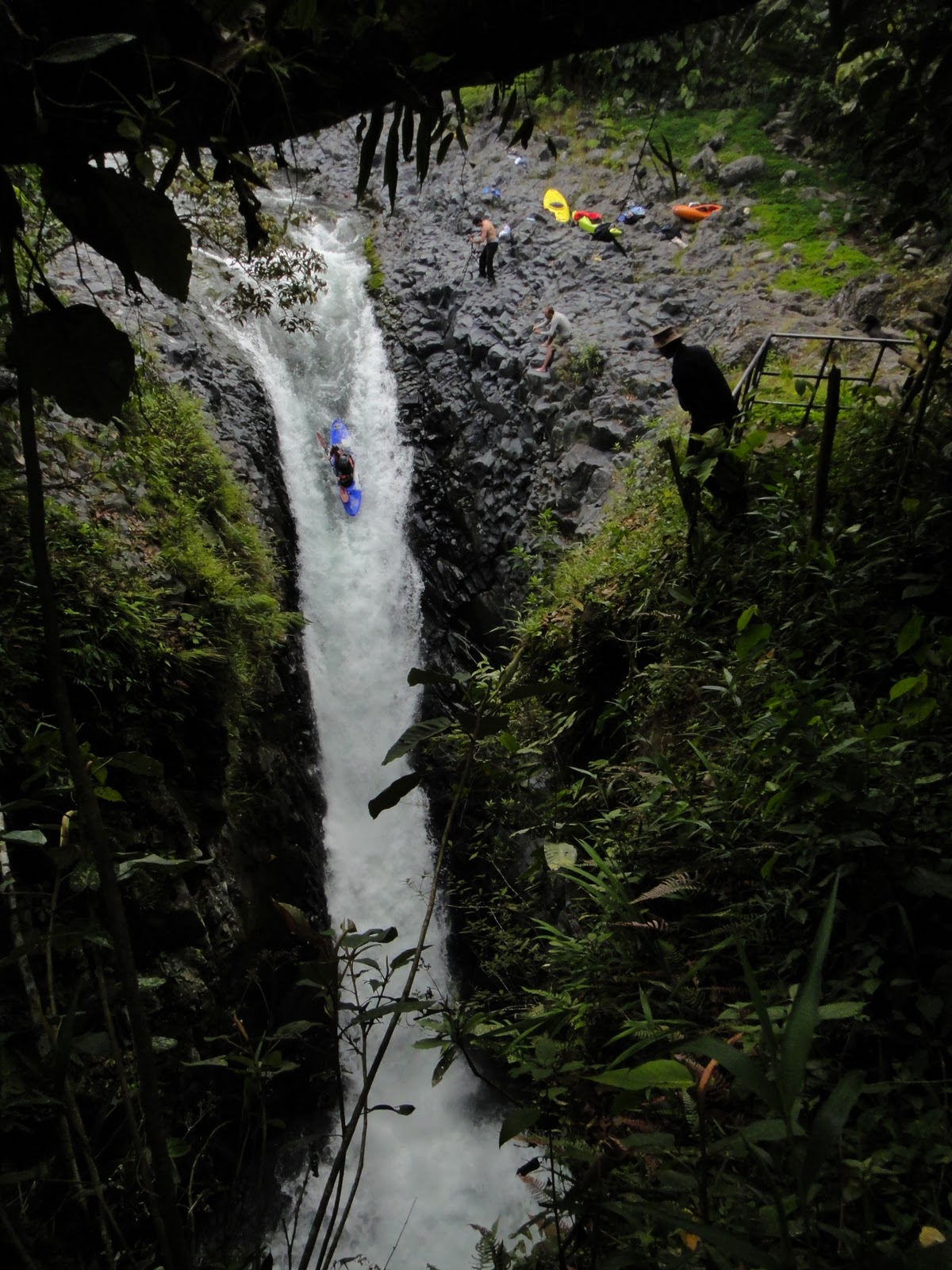
The aforementioned waterfall is approximately 60 feet tall, but only about 6 feet wide.  It falls down through black lava in to a beautiful mini gorge, and is (needless to say) very photogenic.  This waterfall is very clean, but the width makes it fairly intimidating.  The rolling lip and reconnect at the bottom makes this a perfect spot for those less experienced in running big drops.  Out of the 5 guys, only Scotty had run a drop of this size before.

Photo: Craig Parks
Catching a flat-bed to the town of Rio Verde, the boys unloaded and proceeded down to the river.  Craig and I decided it was not a smart idea to bring our gear, in order to avoid the temptation.  We have one final week of trips and cannot risk the possibility of injury.  Not to mention that any injuries incurred would pale in comparison to those caused by Kastorff after he found out.  So we didn´t ever consider running it this time around.

After paying 50 cents to access the river, the boys all decided to run the drop.  This waterfall had only seen 1 descent prior to our mission, by our buddy Dano who came along to help with the ascent out of the mini gorge, and for moral support of course.  (Dano hurt his shoulder earlier in the week and was taking a short break from paddling).  The boys all had to do some rope practice before the huck, so this took a little time.

Photo: Craig Parks

Scotty knocked out the 2nd descent of this drop with a beautiful line, floating through the hole at the top like it wasn´t even there.  ¨First Impression¨ Jake Ament was next, and although his entrance wasn´t ideal, he had a super clean line and a nice hand roll at the bottom after breaking his paddle.  Charlie followed with a stylin´line, as did Bone and Jesse.  Well done boys.
For once, "First Impression" Jake Ament leaves a good one.
Bone gettin' after it.
Broken paddle. (h2o)
Below the drop.
Photo: Craig Parks
The ascent out proved to be quite time and energy consuming.  With some cold beers and truck waiting in Rio Verde, the boys pondered a name for this drop.  Since we were all rather hungover that morning (or afternoon), Chuchaqui Falls seemed quite appropriate and had a rather nice ring to it if I don´t say so myself.  (I will take partial credit for that name, even though I didn´t run the drop)

Next up: a trip to the north of the country for an overnight-er on the Rio Cofanes.

Ciao.

Wednesday, January 26, 2011

The Topo.


The Hammer.
This is a very appropriate first post. The Rio Topo, located in between the cities of Banos and Puyo, is one of the coolest rivers I have ever paddled. Huge white boulders, crystal clear turquoise water, and non stop class IV+ whitewater for 9 miles makes this run a premier destination for any whitewater paddler traveling in Ecuador.

Craig "The Hammer" Parks and I have 2 weeks off between trips, so we jumped on a bus from Quito to Banos as soon as we could.  Arriving at the Hostal Princessa Maria on Sunday, I indulged in some pad thai and cervezas at Cafe Hood, a good start to our 2 week vacation.  Being slightly chu cha qui from a few nights in Quito, we opted to chill out for the evening, in order to be fresh for some boofin' action the next day.
Hostal Princesa Maria and our host, Victor.

Safety first.
A great night sleep on a mattress that felt like a piece of plywood, a little breakfast, and it was time to head to the river.  We hired a truck taxi, threw our boats and gear in the back, and settled in for the hour plus drive to the put-in.  From banos, we headed east along through the Postaza River Gorge.  Lush green mountains and giant waterfalls made the drive to Puente Topo pass in no time.  Truly incredible.  Turning on to a dirt road, we drove up through the jungle, past a few farms and one town (approximate population: 37) to the puente.
  

Arriving at the put-in, sun blazing, I questioned the dry-top recommendation from The Hammer, but once we shoved off in to the river, it made sense. The water was low, but after just a mile or so, I knew that this run was going to be classic. Horizon line after horizon line makes this run steep enough to keep you on your toes, but not so steep that you have to get out every 30 yards.  We boat scouted all but 1 rapid, and only portaged twice.  Three and a half hours and 793 boofs later, the bridge was in sight, but the run was far from over.  The last half mile of this run is probably the steepest section.  After a mandatory portage, you run 4 big rapids, one after the other, and finish in the Rio Postaza...exhausted.  We caught a ride back with a farmer, whose truck bed smelled of cow feces, and arrived back in Banos well before sunset.

The Hammer on some Topo boogie.


Photo: Craig Parks


Photo: Craig Parks


Above the bridge.
The next day, less fresh than we could have been, we headed back for round 2, and found the water a hair lower than the day before.  We blazed the run, and caught a ride back on the coolest shuttle vehicle, possibly in history. A 45 minute ride back to Banos turned in to a 2.5 hour debacle as one of the raft guides got hit by a truck (he's okay), his brother punched the driver of said truck in the face (he's not okay), and then said truck drove off, making it a hit and run.

That's right.
Our shuttle driver was cool and stopped so we could check out the Piallon Del Diablo: a giant waterfall just below the town of Rio Verde.  Apparently, there is a 60 footer upstream that has seen some descents in the past month or so...and apparently some boys are rollin' in to Banos very soon to run it again...maybe I'll join them...maybe not.

El Paillon Del Diablo.
Peace.
Joe